Things around AL Pátio da Figueira
Discover the rich heritage and natural beauty surrounding AL Pátio da Figueira. Explore ancient sites like the Castro do Zambujal, historic landmarks such as the Castle of Torres Vedras and the Chafariz dos Canos, and architectural gems like the Aqueduct and various religious monuments.
Things around AL Pátio da Figueira
Discover the rich heritage and natural beauty surrounding AL Pátio da Figueira. Explore ancient sites like the Castro do Zambujal, historic landmarks such as the Castle of Torres Vedras and the Chafariz dos Canos, and architectural gems like the Aqueduct and various religious monuments. For nature lovers, the nearby Protected Landscape of Serra do Socorro and Archeira offers scenic trails and panoramic views.
Where to Eat
-
Tavern 22
-
Roots Restaurant
-
The Shed
-
Restaurant Midi
-
Pateo do Faustino
-
Restaurant in Varzes II
Tower Lines
Fort of Saint Vincent
The Fort of São Vicente in Torres Vedras formed part of the famous Lines of Torres Vedras, which made up the defensive ring of the capital during the Napoleonic invasions. It was considered the most important fort of the Lines, defending the connection between Lisbon and Coimbra. Construction began in 1809, atop one of the highest hills surrounding the city, Monte de São Vicente. It has a Y-shaped plan and consisted of a series of trenches, ditches, traverses, powder magazines, and 39 original cannons.
Archeira Fort
The Archeira Fort, located in a strategic location within the defensive system of the Lines of Torres Vedras (military work no. 128), is a large structure that belonged to the First Defensive Line, along with the forts of Catefica and Feiteira, located slightly further north, whose objective was the defense of the Ribaldeira and Runa valleys. It has a perimeter of 436.48 m and an area of approximately 9,534.44 m², was equipped with six cannons (12-gauge) and a garrison of 500 men. Although it does not have gun emplacements, inside there are vestiges of what appears to be a semi-buried powder magazine. It is part of the set of Fortifications of the Lines of Torres Vedras classified as a National Monument.
Olheiros Fort
Integrating the defensive system erected to organize the defense of Lisbon after the second French invasion of the Peninsular War in 1809, the Olheiros Fort (also known as Canudo Fort) stands atop a hill overlooking Torres Vedras.
Alqueidão Fort
It is part of a group of eight fortifications (forts and redoubts) in the municipality which, in the context of the Peninsular War (1807-1814), were part of District No. 2 of the 1st Line of the defensive system of the Lines of Torres Vedras: Alqueidão, Caneira, Machado, Moinho do Céu, Novo or Galhofos, Simplício, Trinta and Patameira. These fortifications crossed fire with each other over the accesses to the mountain range, transforming it into a large entrenchment that played a decisive deterrent role in the retreat of the French troops under the command of André Masséna.
Nature
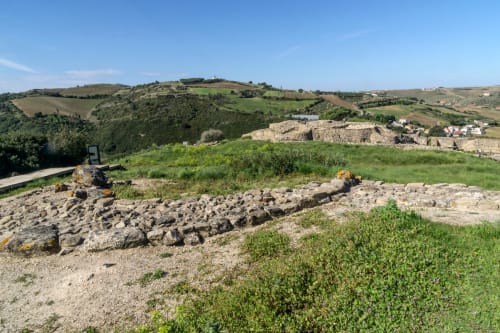
Castro do Zambujal
Discovered in the 1930s by archaeologist Leonel Trindade, the Castro de Zambujal, in the municipality of Torres Vedras, is one of the main fortified settlements of the Iberian Peninsula and one of the largest Chalcolithic settlements in Western Europe, believed to have been inhabited between the first and third millennia BC.
Historic Center
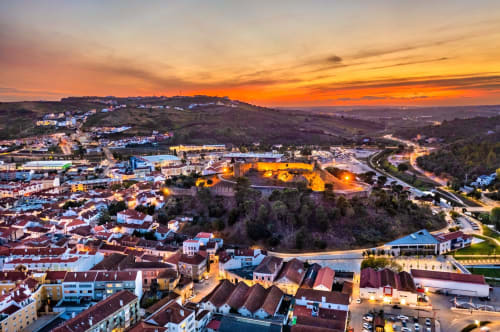
Torres Vedras Castle
The castle of Torres Vedras was conquered from the Muslims by Afonso Henriques in 1148, who donated this fortification to Fuas Roupinho, a knight who collaborated in the struggles for the Christian reconquest of the peninsula and is a protagonist of the legend of Nazaré.
During the reigns of King Dinis, King Fernando, and also King Manuel I, in 1516, the castle underwent reconstruction and improvements to its defenses, a concern that may be linked to the fact that this castle served as a residence for several kings.
During the reigns of King Dinis, King Fernando, and also King Manuel I, in 1516, the castle underwent reconstruction and improvements to its defenses, a concern that may be linked to the fact that this castle served as a residence for several kings.
Fountain of the Pipes
Located within the urban perimeter of Torres Vedras, the existence of the fountain is mentioned in the 14th century. It was fed by the aqueduct and is situated near one of the gates of the medieval town (Porta da Corredoura).
The fountain is a covered pavilion with a ribbed cross vault resting on conical corbels.
Five pointed arches pierce the sides of the pavilion, highlighting the interesting set of Gothic gargoyles that decorate it, and the set of four shields arranged on the faces of the columns: "those on the front displaying the royal coat of arms dating back to the 13th century, most likely from the reign of King Afonso III, and the two on the sides from the same period, representing, in three castles of severe lines, sober in their adornments, the old coat of arms of the ancient Turribus Veteribus."
The fountain is a covered pavilion with a ribbed cross vault resting on conical corbels.
Five pointed arches pierce the sides of the pavilion, highlighting the interesting set of Gothic gargoyles that decorate it, and the set of four shields arranged on the faces of the columns: "those on the front displaying the royal coat of arms dating back to the 13th century, most likely from the reign of King Afonso III, and the two on the sides from the same period, representing, in three castles of severe lines, sober in their adornments, the old coat of arms of the ancient Turribus Veteribus."
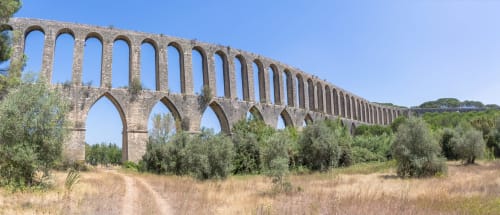
Aqueduct
Located within the urban perimeter of Torres Vedras, this utilitarian Gothic architectural structure extends for more than two kilometers and was built to supply the Chafariz dos Canos fountain, situated in the city's historic center. The date of the original construction is unknown, but the current structure of the pipes was remodeled and expanded in the second half of the 16th century, when King Sebastian granted permission to the local council to extend its structure. This remodeling coincided with the restoration of the Fonte dos Canos fountain in 1561 (parchment belonging to the Church of São Pedro), by order of Infanta Maria.
Interpretation Centre of the Jewish Community of Torres Vedras
The Jewish Community Interpretation Centre showcases the history of the Jewish presence in Torres Vedras. Inaugurated on May 18, 2017, this museum facility of the Municipality of Torres Vedras was produced under the scientific supervision of the Alberto Benveniste Chair of Sephardic Studies, Faculty of Arts, University of Lisbon.
Religious Tourism
Varatojo Monastery
Located on the outskirts of Torres Vedras, the convent was founded by King Afonso V around 1470. It was a royal residence and was known as a "house of revelry."
The first religious members of the Order of St. Francis were received in 1474. It began as a Franciscan Studies Convent, later becoming a College of Apostolic Missionaries, granted by King Pedro II to Friar António das Chagas.
The first religious members of the Order of St. Francis were received in 1474. It began as a Franciscan Studies Convent, later becoming a College of Apostolic Missionaries, granted by King Pedro II to Friar António das Chagas.
Church of Grace
The Convent of Our Lady of Grace was commissioned in the 16th century (1544-1580) by the Augustinian friars (or Gracians) to replace the previous building—founded in 1266—located in the lower part of Torres Vedras, due to the constant flooding it suffered from the Sizandro River.
The building, of enormous and majestic proportions, has a 16th-century convent structure centered on a large cloister, onto which open the areas of worship (convent church, covered cemetery, sacristy and ante-sacristy) and enclosure (gatehouse, library, chapter house, west wing, cells, leper colony, refectory, kitchen and granary).
The building, of enormous and majestic proportions, has a 16th-century convent structure centered on a large cloister, onto which open the areas of worship (convent church, covered cemetery, sacristy and ante-sacristy) and enclosure (gatehouse, library, chapter house, west wing, cells, leper colony, refectory, kitchen and granary).
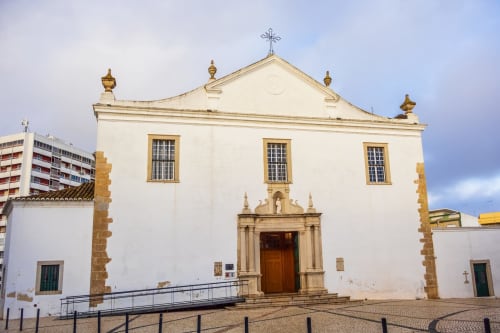
Church of Saint Peter
The Church of St. Peter, along with that of Santa Maria do Castelo, is the oldest of the city's four parish churches and the second oldest in precedence. It is known to have existed during the reign of King Afonso Henriques, but it was completely rebuilt at the beginning of the 16th century, undergoing further reconstruction after the 1755 earthquake. It has a longitudinal plan and its apse faces west, as was customary in medieval churches. It has a small sacristy that connects to the House of the Brotherhood of Poor Clerics, where, in 1929, the Municipal Museum operated, and where the Parish Registry is currently located. This is a very interesting room, whose walls are lined with 18th-century figurative tiles, based on engravings by Cláudio Coelho, and the ceiling with four canvases by Bernardo de Oliveira Góis, representing the evangelists. The bell tower, attached to the right of the church, has a quadrangular plan.
Sightseeing Tour
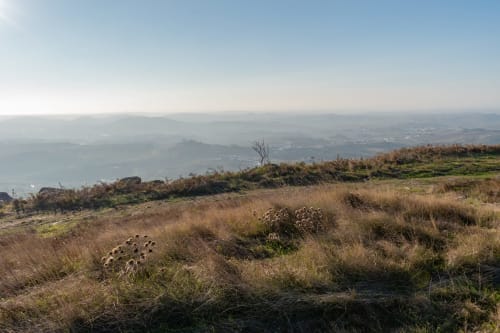
Socorro Mountain
The Protected Local Landscape of the Socorro and Archeira Mountains (PPLSSA) stands out from its surroundings in morphological terms and is made up of the Socorro, Archeira, Galharda and Monte Deixo mountain ranges, although the first two deserve more attention and their toponymy is more locally recognized. The 1223 hectares of the protected local landscape in the municipality of Torres Vedras are mostly distributed among the parishes of Turcifal and the Union of Parishes of Dois Portos and Runa, also encompassing small areas of the Union of Parishes of Santa Maria, São Pedro and Matacães. The area borders the municipality of Mafra to the south, where the southern slope of the Socorro mountain range develops.
PPLSSA features elements with heritage value in terms of natural, historical, cultural and landscape features.
PPLSSA features elements with heritage value in terms of natural, historical, cultural and landscape features.
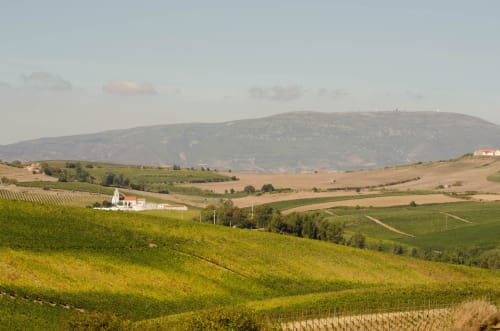
Montejunto Mountain Range
The Serra de Montejunto is a mountain range in Portugal, part of the Montejunto-Estrela System, located in the municipalities of Alenquer and Cadaval. It is the highest natural viewpoint in Estremadura, rising to an altitude of 666 m, with a topographic prominence of 534 meters and an isolation of 53.41 km. This geological structure, 15 km long and 7 km wide, is rich in sinkholes, caves, residual lagoons, necropolises, and prehistoric fossils.